
You Don’t Need to Do Everything Yourself:
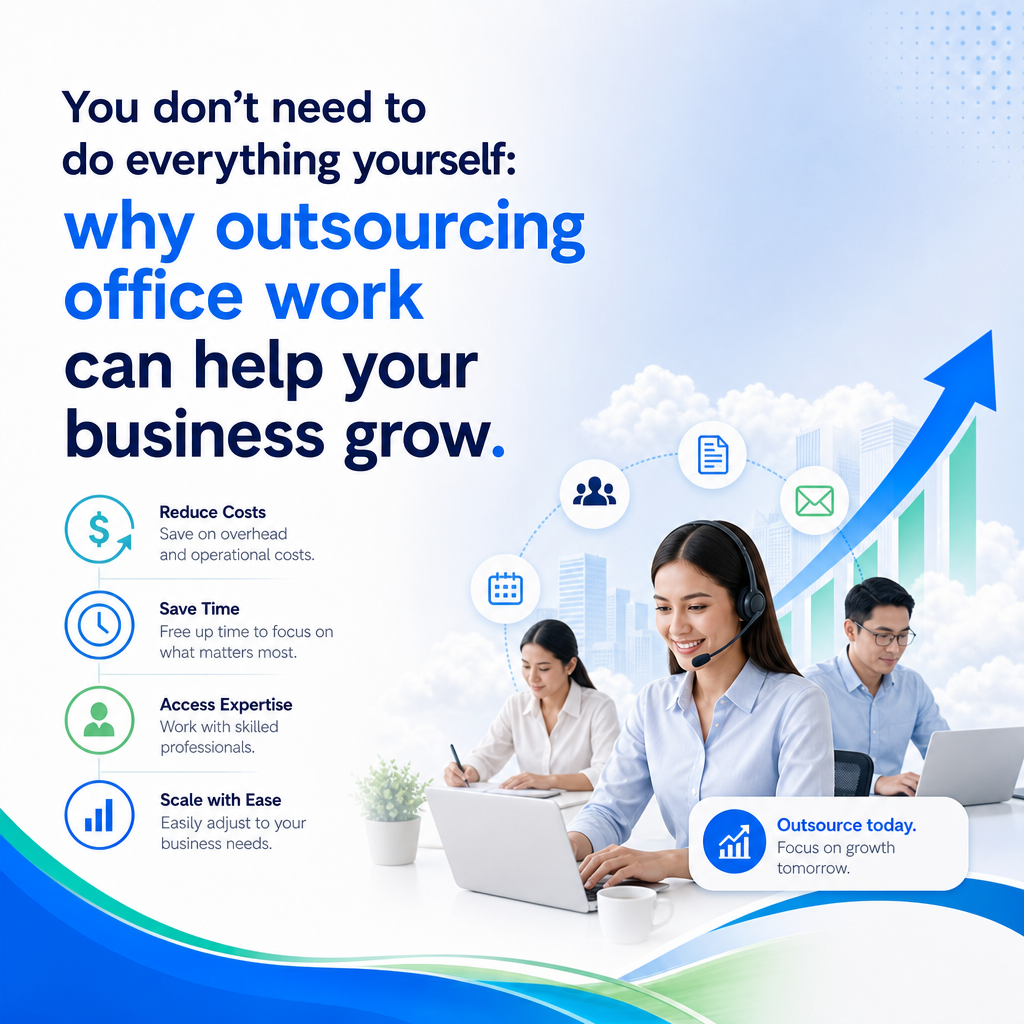
Why Outsourcing Office Work Can Help Your Business Grow
When you start a business, doing everything yourself almost feels like part of the job description. You answer the phone, return emails, send invoices, schedule appointments, update the website, post on social media, follow up with customers, organize paperwork, enter data, and somewhere in the middle of all that—you are also supposed to actually run the business.
At first, that may be necessary. But as your business grows, doing everything yourself can quickly go from being resourceful to becoming the very thing slowing your business down.
There is an important difference between being capable of doing something and being the best person to continue doing it.
If you own a landscaping company, for example, your highest-value activity probably isn't spending two hours organizing receipts. If you're a contractor, you probably shouldn't be sitting in the truck after a job trying to remember which five customers you still need to call back. A realtor may be able to design every social media graphic personally, but is that really the best use of three hours when those same three hours could be spent talking with buyers, sellers, and referral partners?
Your time has a value.
That is one of the biggest mindset shifts business owners need to make when considering outsourcing. Instead of asking, “Can I do this myself?” start asking, “Should I be the person doing this?”
Outsourcing doesn't necessarily mean hiring a full-time employee with salary, benefits, office space, equipment, and everything else that comes with adding someone to payroll. Businesses today have access to virtual assistants, independent contractors, bookkeepers, marketing specialists, administrative professionals, customer-service support, and other skilled workers who can handle specific areas of the business as needed.
And this way of working is becoming increasingly common. Upwork's 2025 Future Workforce Index found that 28% of skilled U.S. knowledge workers were already working as freelancers or independent professionals, representing an estimated $1.5 trillion in earnings during 2024.
Large organizations have also continued increasing their use of outside resources. Deloitte's 2024 Global Outsourcing Survey found that 80% of surveyed executives planned to maintain or increase their investment in third-party outsourcing. Cost still matters, but businesses are increasingly outsourcing for another important reason: access to skilled talent and greater flexibility.
That same principle works for small businesses.
Imagine that you spend eight hours each week answering routine emails, creating invoices, scheduling appointments, updating spreadsheets, following up on leads, and organizing customer information. That's basically an entire workday every week spent on administrative tasks.
Now imagine handing five of those hours to someone who specializes in administrative support.
You didn't simply “get five hours back.” You created five hours that can now be used for sales calls, customer relationships, estimating new jobs, networking, building partnerships, developing new services, or maybe—radical concept here—actually leaving the office at a reasonable hour.
The goal isn't to outsource everything.
Some responsibilities should stay with you. Your vision, important customer relationships, leadership decisions, financial oversight, and the things that truly require your expertise shouldn't simply be handed to someone else because your inbox got scary.
The goal is to identify the work that doesn't require you specifically.
Start by paying attention to tasks that are repetitive, time-consuming, teachable, or constantly being pushed to tomorrow.
Appointment scheduling. Data entry. Customer follow-up. Email organization. CRM updates. Invoicing. Social media scheduling. Website updates. Document preparation. Lead tracking. Research. Bookkeeping preparation. Database cleanup.
Those little jobs may only take 10 or 20 minutes individually, but stack enough of them together and suddenly half your week has disappeared.
A good first step is to track what you do for one week. Write down the tasks you're handling and approximately how long they take. Then divide them into three categories: things only I can do, things someone else could do, and things nobody should be wasting time doing because they need to be automated or eliminated.
That list can be eye-opening.
Growing a business doesn't mean proving you can carry the entire business on your back. Eventually, successful business ownership requires building systems and getting the right people helping with the right work.
You don't have to do everything yourself.
You need to make sure everything gets done.
Fuel Ur Biz can help.
If administrative work, follow-up, online tasks, marketing support, organization, or the everyday office responsibilities of running your business are eating up the time you should be spending growing it, let's talk.